
Criminal Court Records in Greer County
A Greer County criminal court record is the case file the Court Clerk opens the moment the State files charges. It is the criminal case, start to finish. The file gathers the charging document, the docket of every event, each plea, the motions both sides file, the hearings a judge holds, and the disposition and sentence at the end. The Court Clerk in Mangum records, files, and keeps these permanent records for the District Court. The criminal division of that office handles the day-to-day filing work. This case file is broader than the charge itself. For a closer look at the charges as filed, the Greer County court charge records page breaks them down, and the full set of case types lives in the county court records.
The District Court is the trial court that hears criminal cases in Greer County. It handles both felony and misdemeanor matters that the State of Oklahoma brings. A felony is the more serious class of crime, and a misdemeanor is the lesser class. Both move through the same District Court and the same Court Clerk. City of Mangum ordinance and city traffic cases are different. Those go to the Mangum Municipal Court, a separate court with its own clerk and docket.
How to Search Greer County Criminal Court Records
Greer County points the public to On Demand Court Records, known as ODCR, for District Court case files. Greer appears in the ODCR court list, and the Court Clerk links to it from the official county site. Public docket searching there is free. The Oklahoma State Courts Network, or OSCN, is the second official statewide channel, though it may show an access check before a search runs.
- Open odcr.com or use the Greer Court Clerk's court records link.
- Choose Greer from the court dropdown, then enter a defendant name in Last, First format or a case number if you have one.
- Narrow the results by court, case type, and filing date, using a type such as Criminal Felony Proceedings or Criminal Misdemeanor Proceedings.
- Open the case to read the docket, the parties, the events, and the disposition.
- Request a certified copy from the Court Clerk by phone or mail when the document is not online.
For a statewide criminal history rather than one case, the Oklahoma State Bureau of Investigation runs name-based and fingerprint checks. The court file in Greer County is the source for the case-level detail. When a citation or case number is known, OSCN and OSCN e-payments can pull the docket and any payment due.
Stages of a Criminal Case
A criminal case moves through set stages, and each one leaves a mark in the record. The docket shows the date of every step. Reading those entries in order is the clearest way to follow what happened and where the case stands now. Some cases run the full course to a trial. Many end earlier with a plea or a dismissal.
Case flow: Charges Filed › Arraignment › Pretrial / Motions › Plea or Trial › Disposition › Sentencing
| Stage | What Happens |
|---|---|
| Arraignment | The court reads the charges and the defendant enters a plea. Bond is set and counsel is addressed. |
| Pretrial / Motions | Lawyers file motions, trade evidence, and argue what the court may hear. Many cases resolve here. |
| Plea or Trial | The defendant pleads guilty or no contest, or a judge or jury weighs the proof at trial. |
| Sentencing | After a plea or a guilty verdict, the judge sets the penalty: fines, costs, probation, or custody. |
Note: A bench warrant can issue at any stage if a defendant misses a hearing, and that warrant will show up as a docket event in the case file.
What a Greer County Criminal Court Record Shows
Open a Greer County criminal case and the public docket lays out the core facts of the matter. Common fields include the case number, the case type, the court, the party names, the filing date, the case status, and the docket entries. Criminal files add more. They can show the charge description, the offense statute, the arresting agency, the bond, the plea, the sentence, probation terms, fines, costs, and any warrant. The table below maps the main fields to what each one tells you.
| Field | What It Shows |
|---|---|
| Case Number | The District Court ID, with a prefix such as CF for felony or CM for misdemeanor. |
| Defendant | The person charged, plus related parties and attorneys of record. |
| Charges | The offense alleged, the statute cited, and the severity level. |
| Plea | The defendant's answer to each charge: guilty, not guilty, or nolo contendere. |
| Disposition | The current or final outcome of each charge in the case. |
| Sentence | The penalty imposed, including fines, costs, probation, or jail or prison time. |
Charges vs. Convictions
A charge is not a conviction. Being charged means the State has accused a person and filed the case. A conviction means a court has found that person guilty, by plea or by verdict. A criminal court record can show charges that were later dropped, dismissed, or that ended in an acquittal. Reading the disposition for each count is the only way to tell a live accusation from a final result. The charge record and its codes are covered in more depth on the county court charge records page.
| Charge | Conviction | |
|---|---|---|
| Stage | Accusation | Verdict or plea |
| Burden of Proof | Probable cause | Beyond reasonable doubt |
| Public Record | Yes | Yes |
Reading Dispositions and Sentences
The disposition is the outcome of a charge, and it sits at the heart of any criminal record. A case can carry several charges, and each one can end in its own way. The sentence appears once a charge ends in a conviction. It spells out the penalty in plain terms: a fine, court costs, a term of probation, time in the county jail, or a prison sentence served through the state. These are the most common disposition terms you will see in a Greer County file.
- Guilty: the defendant admits the charge or a court finds the proof sufficient.
- Not guilty: a plea entered, or an acquittal returned at trial.
- Nolo contendere: a no-contest plea treated like guilty for most purposes.
- Dismissed: the charge is dropped by the court or the prosecutor.
- Deferred: judgment is delayed, and the case may be dismissed once terms are met.
A deferred sentence is worth a second look. The judge holds off on a formal judgment while the person completes probation or other conditions. If the terms are met, the charge can be dismissed. The docket will note the deferral, the review dates, and the final order.
Prosecution and Defense in Greer County
State criminal cases in Greer County are prosecuted by the District Attorney for District 3. The office is described on the Oklahoma District Attorneys Council page for District 3, which names Dan Jacobsma as the District Attorney.
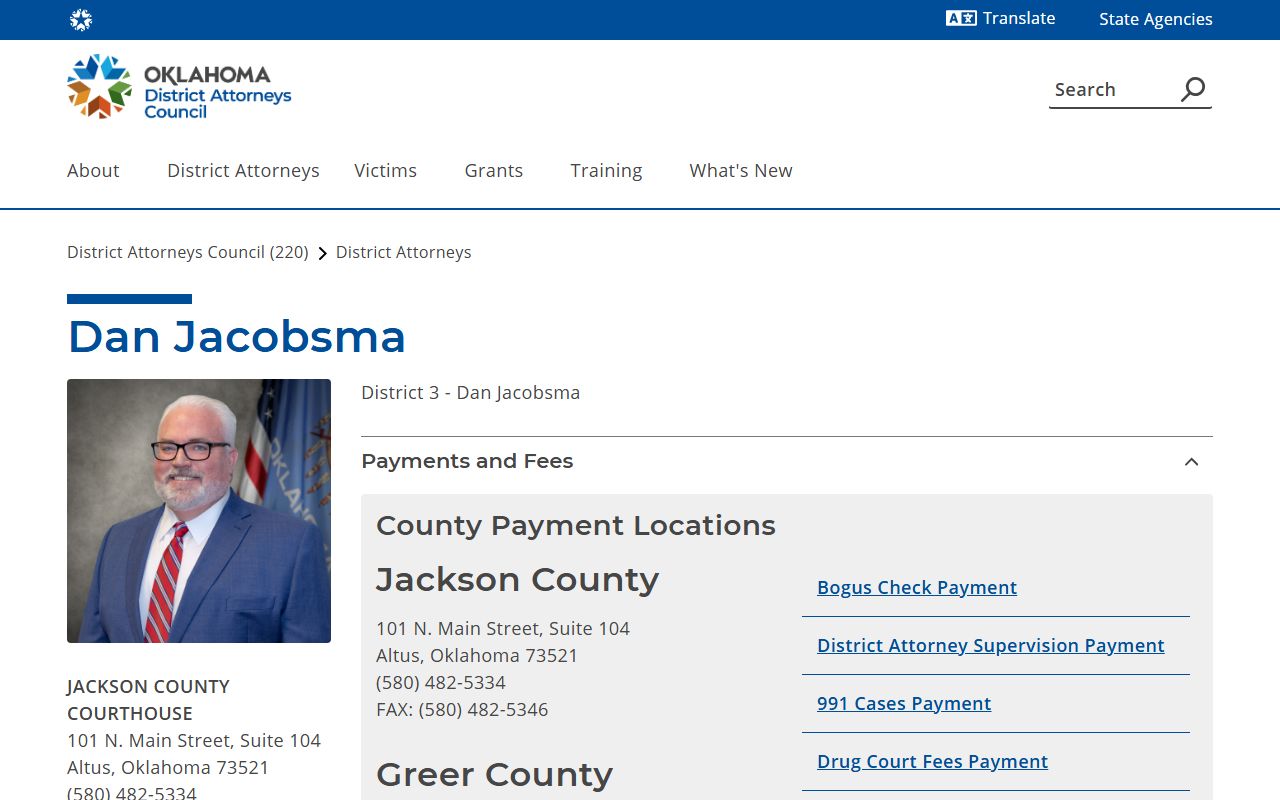
That District 3 office covers Greer along with Jackson, Harmon, Kiowa, and Tillman Counties. The Greer County DA works out of the courthouse at 106 E. Jefferson, Room 6, in Mangum, and the office phone is 580-782-3653. The prosecutor decides what charges to file, and those choices drive the case record from the first filing forward.
People who cannot afford a lawyer are defended through the Oklahoma Indigent Defense System. The agency is profiled on the Oklahoma Indigent Defense System site.

For Greer County, OIDS handles non-capital trial work out of its Altus regional office at 123 W. Commerce St., Suite 100, with a phone line at 580-782-2429. Both the prosecution and the defense file motions, witness lists, and other papers that become part of the public case file, so the docket reflects the work of each side.
Note: The court does not give legal advice, so anyone facing a charge should speak with a defense lawyer or apply for an appointed one before a hearing.
Sealed vs. Expunged Records
Not every criminal record stays open forever. Oklahoma lets eligible people seal or expunge certain records by court order. The two are not the same. A sealed record is hidden from public view but still exists. An expunged record is treated as though it never happened, and access is far tighter. Eligibility for expungement is set by statute under Title 22, Section 18.
| Sealed | Expunged | |
|---|---|---|
| Visibility | Hidden from public | Destroyed / treated as never existed |
| Law Enforcement | Limited access | Very limited |
| Eligibility | Set by court order under state rules | 22 O.S. § 18 categories |
Clearing a Greer County record follows a set path. The Oklahoma State Bureau of Investigation cannot pre-approve eligibility, so the court decides.
- Identify the case in ODCR or OSCN, or by calling the Court Clerk.
- Confirm the record fits a Title 22, Section 18 category.
- File the petition in the Greer County District Court where the case sits.
- Give notice to the district attorney, OSBI, the arresting agency, and other record holders.
- If the court grants the order, send certified copies to each agency that holds the record.
Public Access to Criminal Court Records
Adult criminal court files are public records in Oklahoma. The Open Records Act sets the baseline rule: public bodies must allow access to public records unless a statute makes a record confidential. In practice, that means Greer County criminal cases are open to search and copy, subject to lawful fees and a few exceptions. For certified copies, older files, or documents not posted online, the Court Clerk is the source. Call 580-782-3665 or write to P.O. Box 216, Mangum, OK 73554, to make a records request.
Key Statutes:
Oklahoma Statutes Title 51 § 24A.1 - the Open Records Act requires public access to public records unless a statute makes them confidential.
Oklahoma Statutes Title 22 § 18 - sets which criminal records an eligible person may petition to seal or expunge.
Background Check Considerations
There is a real gap between a casual court lookup and a formal background check. Reading a public docket on ODCR tells you what one case shows. A background check used for hiring, housing, or credit is regulated by federal law and must follow strict rules on accuracy, notice, and consent. A name match alone is not proof, since two people can share a name. Always confirm a record against the official court file before acting on it.
Important: This site is not a consumer reporting agency under the Fair Credit Reporting Act, and its records may not be used for credit, employment, tenant, or insurance decisions.
Restricted Criminal Court Records in Greer County
Some criminal records are not open to a routine search. Juvenile cases are the clearest example. Under Title 10A, Section 2-6-102, juvenile court, agency, and law-enforcement records are generally confidential, so they are not searched like adult cases. Sealed and expunged records also drop out of public view once a judge signs the order, and ODCR or OSCN may stop showing the case or limit the name.
Other limits apply too. Adoption records and many mental-health proceedings carry their own confidentiality rules. Personal identifiers such as Social Security numbers, full account numbers, and the names of minors are redacted under court guidance. An active warrant or a sealed exhibit can also be withheld while a matter is pending. When a case will not load online, the Court Clerk can confirm whether it is sealed, restricted, or simply not yet digitized.
Note: A search that turns up nothing does not always mean a clean record, since the file may be sealed, confidential, or held only on paper at the courthouse.